
Active and passive investing: how the two approaches differ
Team FINWEL · 30 Jul 2026 · 4 min read
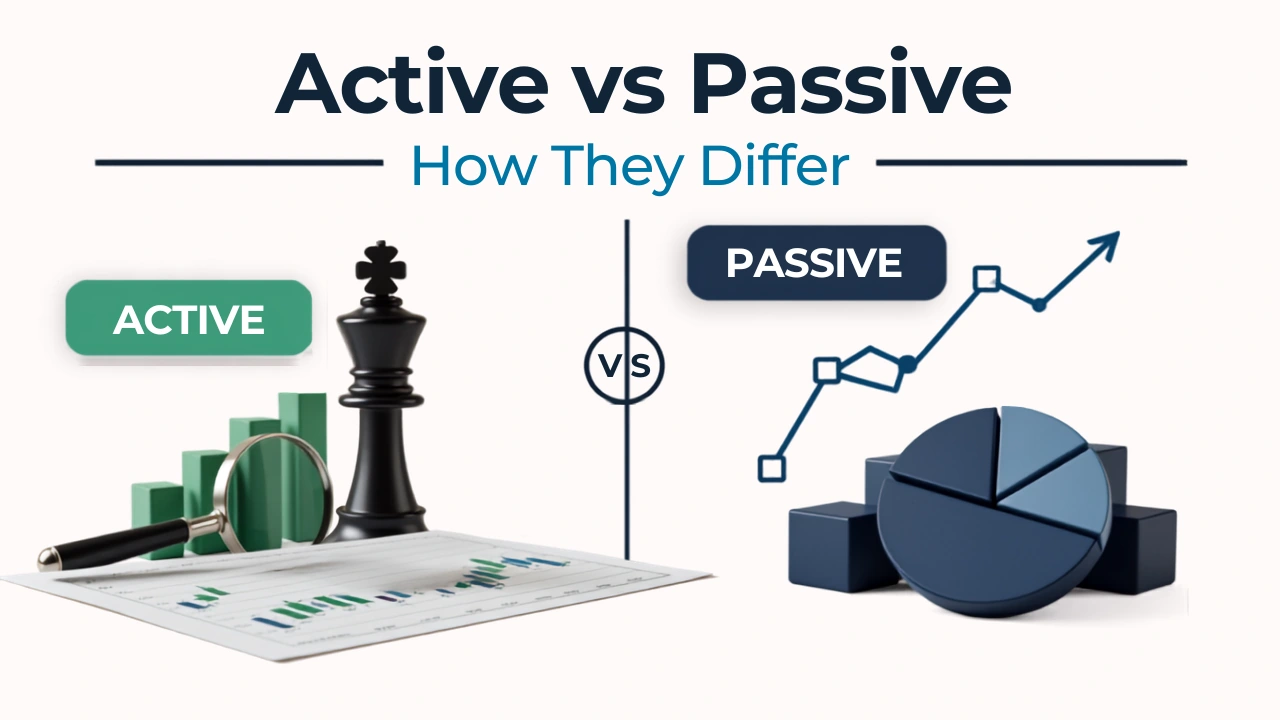
Almost every fund you can buy in India falls into one of two camps. One employs a manager to choose what to hold, aiming to do better than a benchmark. The other simply copies the benchmark. The argument between them generates a great deal of noise, much of it from people with something to sell. This is what actually separates the two, and what the evidence does and does not tell you.
What each approach is trying to do
An active fund has a benchmark and a mandate to beat it. The manager researches companies, forms views, and builds a portfolio that deliberately differs from the index. The whole proposition is that skill produces a return above the benchmark, after costs.
A passive fund has the same benchmark and no ambition to beat it. It holds the index constituents in index weights, and its job is to deliver the index return minus a small cost. Success for a passive fund is a very small gap to the index, not a large positive one.
That difference in objective is why comparing them on returns alone tells you little. A passive fund that tracked its index closely did its job perfectly even in a year the index fell.
Cost, and why it is the one certainty
Cost is expressed as the total expense ratio, charged as a percentage of assets and deducted daily from the net asset value. You never receive a bill, which is precisely why it goes unnoticed.
Index funds and exchange traded funds in India generally carry materially lower expense ratios than actively managed equity funds. The exact numbers vary by scheme and change over time, so look them up in the scheme information document rather than relying on a figure in an article.
The important structural point is this. The cost difference is certain and paid every year. The excess return an active manager might deliver is uncertain and paid only if the manager is right. That asymmetry is the heart of the debate, and it is arithmetic rather than opinion.
What the evidence shows, on both sides
Studies comparing active funds against their benchmarks over long periods, in India and elsewhere, consistently find that a majority of active funds underperform their benchmark after costs over ten and fifteen year windows. This finding is robust and it is the strongest argument the passive side has.
The active side makes several responses that are also worth taking seriously. A majority underperforming does not mean all do, and the question of whether the minority can be identified in advance is genuinely open rather than settled. Survivorship matters, since funds that closed or merged drop out of the record. Index composition matters too, because a concentrated index reflects the concentration of the market rather than a diversification decision. And in less researched segments of the market, the gap between price and value is wider, which is where an active manager has more to work with.
The honest summary is that the average active fund has struggled to beat its benchmark after costs, and that this says less about any particular fund than the headline suggests.
Where the two behave differently in practice
Manager dependence
An active fund's results are tied to the people running it. When a manager leaves, the fund you own is not quite the fund you bought, even though the name has not changed. A passive fund has no such dependency.
Concentration risk sits in different places
An active fund can concentrate deliberately, and a manager who takes large positions will produce results that diverge sharply from the index in both directions. A passive fund inherits whatever concentration the index has. A broad market index dominated by a handful of large companies is a concentrated portfolio, whether or not anyone chose it.
Predictability
A passive fund's behaviour relative to its index is highly predictable. An active fund's is not, which is the point of it. Neither of those is a virtue on its own.
What is identical between them
Worth knowing, because it is often assumed otherwise.
- Regulation. Both sit under the same SEBI framework, with the same disclosure requirements and the same categorisation rules
- Taxation. Tax treatment depends on what the fund holds, not on whether it is actively or passively managed. An equity-oriented passive fund and an equity-oriented active fund are taxed identically
- Market risk. Neither protects you from a falling market. A passive fund follows the index down and an active fund may fall more or less, but neither is a hedge
What to look at, rather than what to conclude
- The expense ratio, from the scheme information document, and whether you are in a direct or a regular plan
- For a passive fund, the tracking difference against the index over multiple periods, not one
- For an active fund, how long the current manager has been in place and whether the portfolio reflects the stated mandate
- Whether the benchmark is the right one for what the fund actually holds
- Your own holding period, since costs compound over time and so do the consequences of a manager change
The two approaches are answers to different questions rather than competitors at the same task. Which one suits a particular investor depends on that investor's circumstances, and that is a conversation to have with a qualified adviser rather than a conclusion to draw from an article.
Want a Chartered Accountant on your return?
Book a free demo and see how FINWEL files, reviews and advises, end to end.
On this page
Start managing your money with FINWEL.
Create your account and file, invest and plan, with a Chartered Accountant in your corner.