
ETFs and mutual funds: the differences that matter
Team FINWEL · 30 Jul 2026 · 4 min read
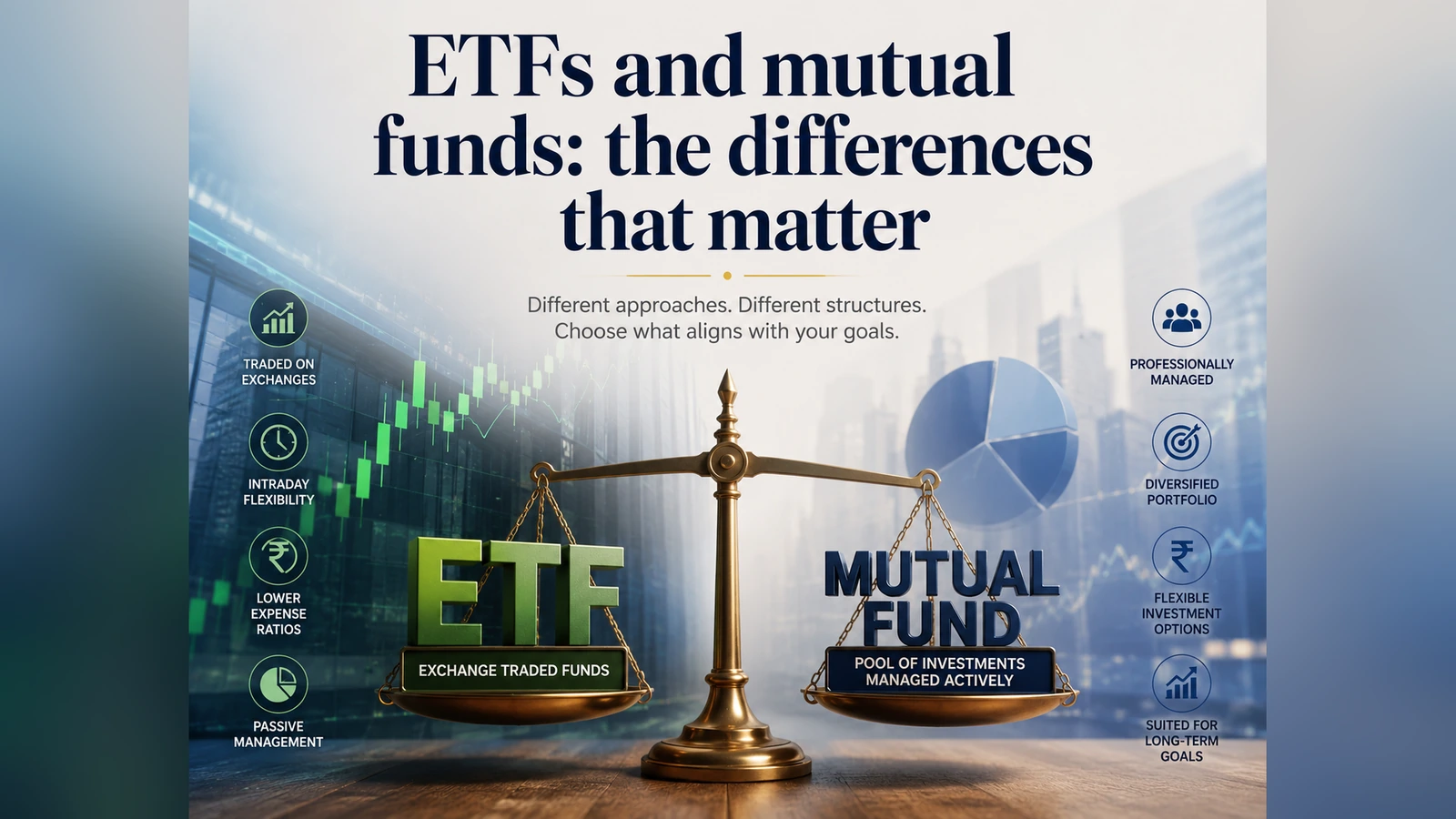
An exchange traded fund and a mutual fund can hold identical portfolios and still give you a different experience and a different result. The portfolio is not where they differ. How you buy and sell is, and everything that follows comes from that.
The one structural difference
When you buy a mutual fund, you transact with the fund house. Your money creates new units at the net asset value calculated at the end of that day. When you sell, the units are extinguished at that day's net asset value. There is no other party.
When you buy an exchange traded fund, you transact on the stock exchange with another investor. You need a demat account and a broker. The price you pay is whatever the market is quoting at that moment, which is related to the net asset value but is not the same number.
Price and net asset value are two different things
An exchange traded fund's net asset value is the value of what it holds. Its market price is what someone will pay for a unit right now. When the price sits above the net asset value the unit trades at a premium, and below it at a discount.
The mechanism that keeps the two close is arbitrage. Authorised participants can create and redeem units in large blocks directly with the fund, so when a gap opens they have an incentive to close it. Funds also publish an indicative net asset value through the trading day so buyers can see roughly what the units are worth.
That mechanism works well in liquid funds and works poorly in thin ones. On a fund with little trading volume, gaps can be wide and can persist, which is why a premium paid at purchase is a real cost even though it appears nowhere in the expense ratio.
What each one costs you
| Cost | Mutual fund | Exchange traded fund |
|---|---|---|
| Expense ratio | Usually higher | Usually lower |
| Brokerage | None | Charged on every trade |
| Bid and ask spread | None | Paid on entry and exit |
| Premium or discount | None | Possible on both sides |
| Demat charges | Not required | Account and holding costs apply |
The headline expense ratio favours the exchange traded fund and the transaction costs favour the mutual fund. Which wins depends on how often you trade and how much you invest at a time. A monthly investor putting in small amounts pays those trading costs twelve times a year on small sums, which is exactly the case where a low expense ratio does not compensate.
The practical differences
- A mutual fund needs no demat account. An exchange traded fund does
- Systematic investment plans are straightforward in a mutual fund. In an exchange traded fund they depend on your broker offering the facility, and each instalment is a market trade
- You can buy a fractional amount of a mutual fund. An exchange traded fund trades in whole units
- An exchange traded fund can be bought and sold through the day. A mutual fund gives you one price per day
- A mutual fund can be bought directly from the fund house. An exchange traded fund requires the exchange
- Liquidity in a mutual fund comes from the fund itself. In an exchange traded fund it comes from the market, and varies enormously between schemes
Tax treatment follows the holding, with one wrinkle
For most purposes tax depends on what the fund holds rather than how it is wrapped. An equity oriented scheme is taxed as equity whether it is a mutual fund or an exchange traded fund.
The exception matters. Holding period thresholds depend on whether the units are listed. Exchange traded fund units are listed and turn long term in twelve months. Units of an unlisted scheme, including a fund of funds that invests in an exchange traded fund, need twenty four months. For gold, silver and international exposure that is a real difference between two routes to the same underlying asset.
What to check before choosing between them
- The traded volume of the exchange traded fund over the last several days, not its assets under management
- The bid and ask spread at the time you intend to trade
- Whether the units are currently at a premium or a discount to the indicative net asset value
- Your own pattern. Frequent small investments favour the mutual fund route on cost
- Whether you already have and pay for a demat account
- The expense ratio of both routes to the same index, and the tracking difference of each
Neither structure is better. They suit different investors and different habits, and the choice deserves more thought than a comparison of expense ratios alone.
Want a Chartered Accountant on your return?
Book a free demo and see how FINWEL files, reviews and advises, end to end.
On this page
Start managing your money with FINWEL.
Create your account and file, invest and plan, with a Chartered Accountant in your corner.