
Old regime or new regime: the deductions you actually lose
Team FINWEL · 30 Jul 2026 · 5 min read
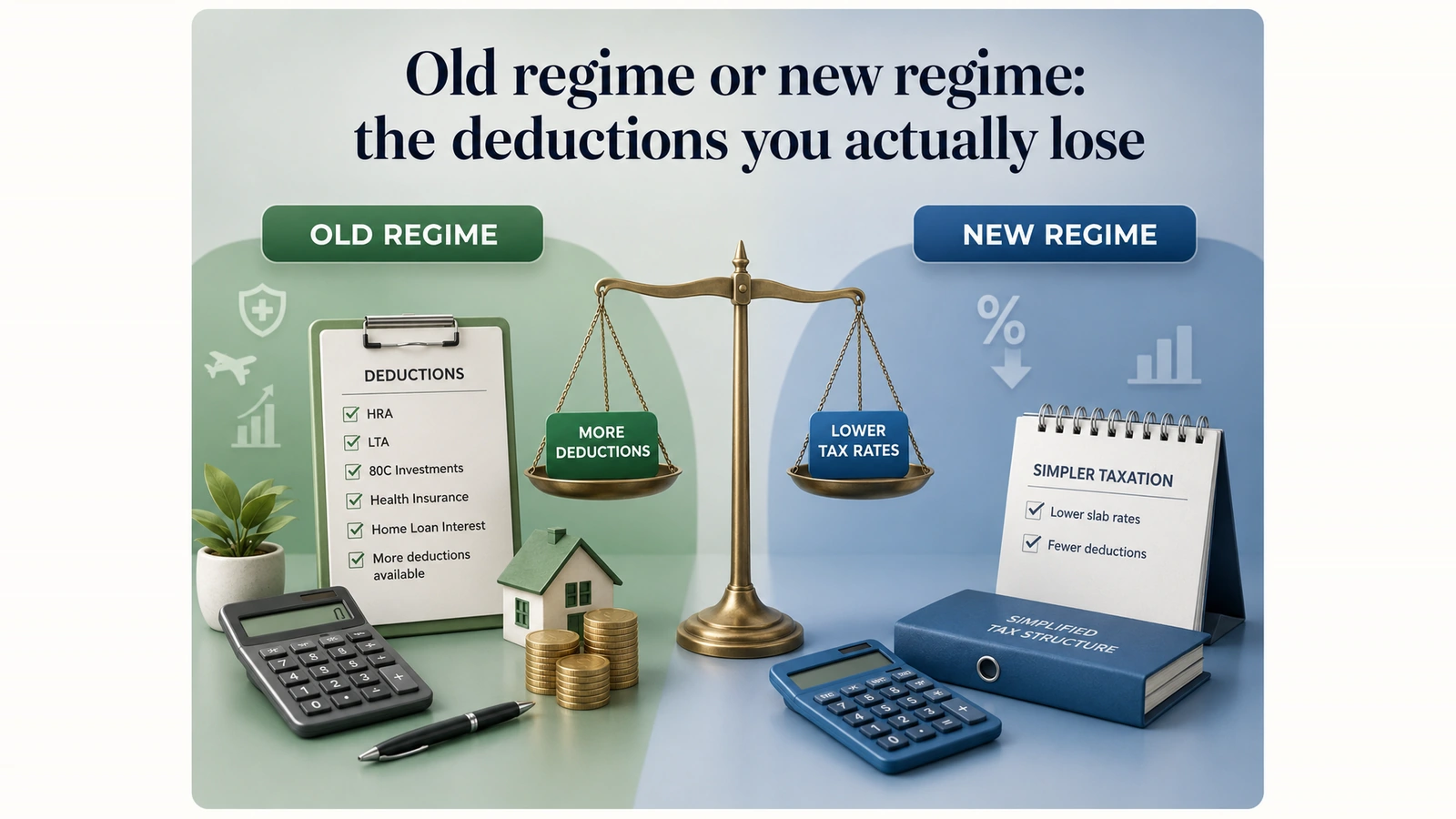
The new regime is the default. If you file without choosing, this is how your tax is computed, and for most salaried taxpayers that default is now the cheaper answer. But not for everyone, and the gap can run to tens of thousands of rupees a year. This is what you give up when you take the default, and when it is worth opting out.
The rates, side by side
For FY 2025-26, assessment year 2026-27, the new regime runs in clean bands of four lakh rupees.
| Taxable income | New regime | Old regime |
|---|---|---|
| Up to Rs 2,50,000 | Nil | Nil |
| Rs 2,50,001 to Rs 4,00,000 | Nil | 5% |
| Rs 4,00,001 to Rs 5,00,000 | 5% | 5% |
| Rs 5,00,001 to Rs 8,00,000 | 5% | 20% |
| Rs 8,00,001 to Rs 10,00,000 | 10% | 20% |
| Rs 10,00,001 to Rs 12,00,000 | 10% | 30% |
| Rs 12,00,001 to Rs 16,00,000 | 15% | 30% |
| Rs 16,00,001 to Rs 20,00,000 | 20% | 30% |
| Rs 20,00,001 to Rs 24,00,000 | 25% | 30% |
| Above Rs 24,00,000 | 30% | 30% |
Health and education cess of 4 per cent applies on top under both regimes. Surcharge applies above 50 lakh rupees of income, rising through 10, 15 and 25 per cent, with the old regime carrying a further 37 per cent band above five crore. The new regime caps surcharge at 25 per cent, which is why very high earners often find the new regime cheaper even with substantial deductions.
Why twelve lakh is tax-free, and where that claim misleads
The slabs alone would tax a taxable income of twelve lakh rupees at 60,000 rupees. The section 87A rebate for FY 2025-26 is up to 60,000 rupees for a resident individual with taxable income up to twelve lakh, which cancels that figure exactly. So the tax is nil. Add the 75,000 rupee standard deduction and a salaried person can earn up to 12,75,000 rupees gross and pay nothing.
Two conditions are worth holding on to. The rebate is for resident individuals only, so a non-resident does not get it. And it applies only to income taxed at normal slab rates. Capital gains, lottery and online gaming income are taxed at special rates and the rebate does not touch them. A taxpayer with eight lakh of salary and five lakh of capital gains does not walk away with nil tax.
Cross twelve lakh of taxable income and the rebate disappears entirely rather than tapering. Marginal relief exists to stop a small rise in income costing more in tax than the income gained, and it operates between twelve lakh and roughly 12,75,000.
What the new regime takes away
Almost every deduction a taxpayer thinks of as tax planning is unavailable. The main ones:
- Section 80C, so no benefit for provident fund, life insurance premium, ELSS, tuition fees, principal repayment on a home loan or five-year deposits
- Section 80D, health insurance premium for yourself and your parents
- House rent allowance and leave travel allowance
- Section 24(b) interest on a self-occupied house, up to two lakh rupees
- Section 80TTA and 80TTB on savings and deposit interest
- Section 80E on education loan interest, and 80G on donations
- The higher basic exemption that senior and super senior citizens get under the old regime
What survives
Less than most people assume, but the survivors matter.
- The standard deduction of 75,000 rupees for salaried taxpayers and pensioners, higher than the old regime's 50,000
- Section 80CCD(2), your employer's contribution to NPS, which is the single largest planning lever left in the new regime
- Section 80JJAA for new employment, and 80CCH for Agniveer contributions
- The family pension deduction, 25,000 rupees or one third, whichever is lower
- Employer contributions to recognised provident funds and gratuity within existing limits
- Interest on a let-out property, though the loss it creates cannot be set off against other heads of income
That last point catches people. Interest on a self-occupied house is simply gone in the new regime. Interest on a let-out property survives as a deduction against rental income, but if it produces a loss you cannot set that loss against your salary. Under the old regime you could, up to two lakh rupees a year.
Where the break-even falls
There is no single number, because it depends on your income level and which deductions you actually have rather than which ones you could theoretically claim. The useful way to think about it is that the new regime's lower rates and larger rebate have to be beaten by real deductions, and for many salaried taxpayers at middle incomes they are not.
The honest test is arithmetic on your own figures, both ways, with the deductions you can actually substantiate. Not the ones you intend to make before March.
Two situations where the old regime often still wins
A large home loan on a self-occupied house
Two lakh rupees of interest under section 24(b), plus principal repayment inside 80C, plus 80D, is a substantial block of deductions that the new regime discards entirely. For a taxpayer with a recent home loan on the house they live in, the old regime frequently remains cheaper.
Senior citizens with interest income
The old regime gives a higher basic exemption by age and allows section 80TTB, up to 50,000 rupees of interest from deposits. The new regime gives neither. A retired taxpayer living on deposit interest is often better off opting out of the default.
The switching rule that catches business income
If your income is salary, house property, capital gains or other sources, you may choose your regime each year when you file. There is no lock-in.
If you have income from business or profession, the position is stricter. You must file Form 10-IEA to opt out of the new regime, and by the due date. Having opted out, you may return to the new regime, but once you do you cannot opt out again. That is a one-way door, and it is worth understanding before you use it rather than after.
Before you decide
- Compute both ways on your actual figures, not on the deductions you plan to make
- Check whether your deductions can be substantiated if the return is examined
- Look at what your employer contributes to NPS, which survives in the new regime
- If you have business income, understand the Form 10-IEA timing and the one-way switch back
- Remember that the rebate does not extend to capital gains
The default is the right answer for a great many taxpayers, which is presumably why it is the default. It is not the right answer for all of them, and the only way to know which group you are in is to run the numbers.
Want a Chartered Accountant on your return?
Book a free demo and see how FINWEL files, reviews and advises, end to end.
On this page
Start managing your money with FINWEL.
Create your account and file, invest and plan, with a Chartered Accountant in your corner.