
Reading your AIS and TIS: why the numbers may not match your records
Team FINWEL · 30 Jul 2026 · 5 min read
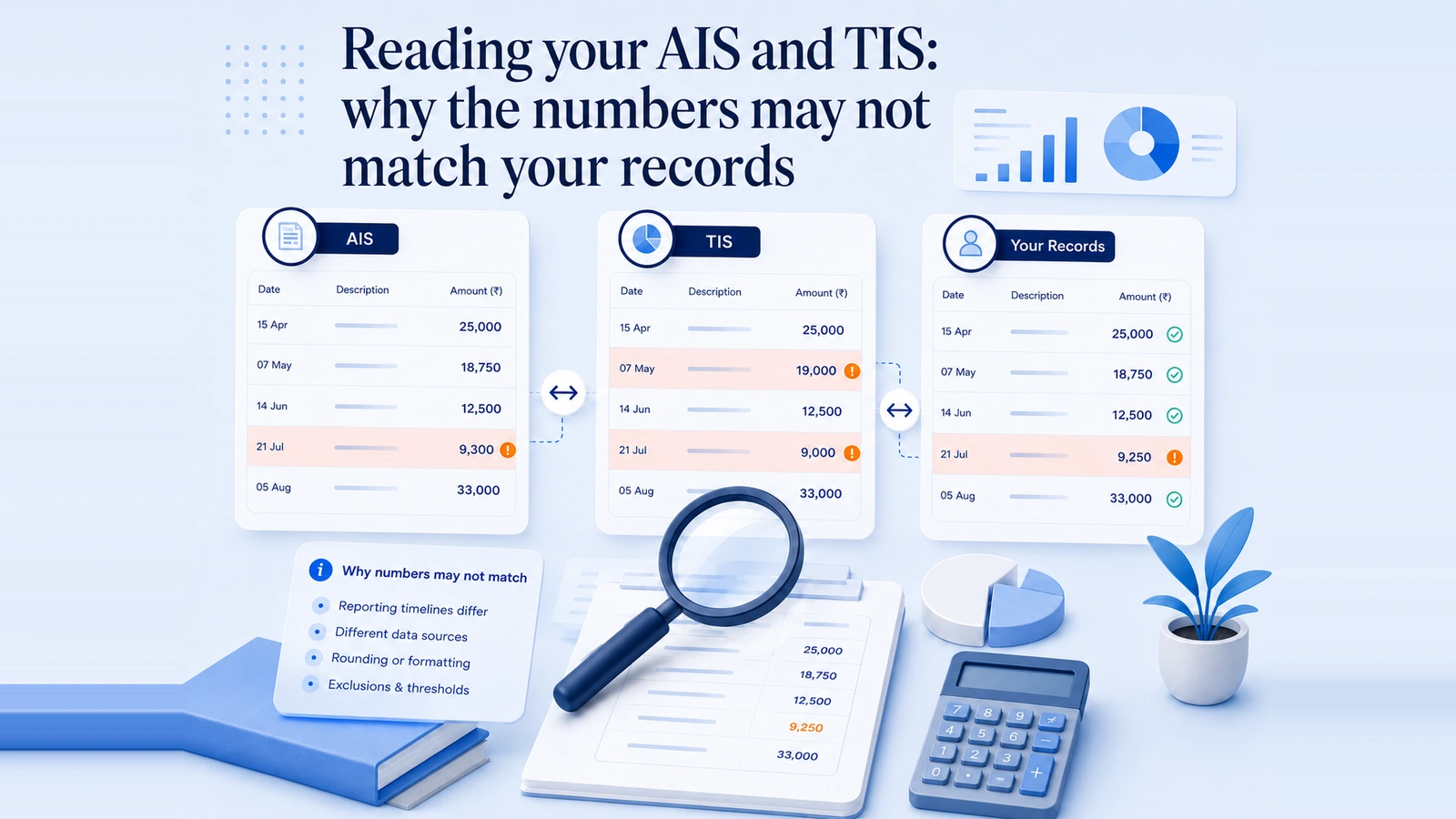
Your Annual Information Statement almost never matches your own records exactly, and that is normal rather than alarming. The mistake most taxpayers make is treating it as the authoritative version of their income and copying it into the return. It is a compilation of what third parties reported about you, and third parties make mistakes.
What each document is
The Annual Information Statement, usually called AIS, is the detailed record. It lists what banks, registrars, depositories, brokers, fund houses, employers and other reporting entities told the department about your transactions, transaction by transaction.
The Taxpayer Information Summary, or TIS, is the processed view. It aggregates the same information by category and shows a derived value for each. The derived value takes your feedback into account, which is the only reason to care about the distinction.
Form 26AS still exists and still matters. It carries tax deducted and collected at source, and it is what supports your credit claim.
All three are on the income tax e-filing portal. The downloaded PDF is password protected, opening with your PAN in lower case followed by your date of birth in the format the portal specifies.
Why the numbers differ, and what each cause means
Joint holdings reported in full against both holders
Interest on a jointly held deposit is frequently reported at its full value against each holder rather than split. If a joint fixed deposit earned interest and you see the whole amount in your AIS, the other holder probably sees the same figure. You report your share, not what appears on screen.
Gross rather than net
Interest is reported before tax deducted at source. If your bank credited you a net amount and the AIS shows a larger figure, both are correct. The difference is the tax already deducted, which you claim as credit.
Accrual against receipt
Banks report interest on cumulative deposits as it accrues, not when it is paid. If you have been recognising it only on maturity, the AIS will not match in any single year even though it matches across the term.
Sale value, not gain
Securities and mutual fund transactions are reported at gross sale value. That figure is not your income. Your income is the gain after cost of acquisition. A large number in the AIS against securities does not indicate a large tax liability.
Corporate actions and split scrips
Bonus issues, splits, mergers and demergers are reported inconsistently, and cost of acquisition is frequently absent or wrong. A split holding can appear as a sale with no cost against it, which produces a gain that never occurred.
Duplication
The same transaction can be reported by more than one entity, or a reporter can file twice. Duplication in capital gains is particularly easy to miss, because the individual figures look plausible and only the total is wrong.
Timing
Reporters file and revise on their own schedule. The AIS you saw in June may differ from the one available in September. This matters if you file early, because your return can end up disagreeing with a statement that changed after you submitted it.
Misattribution
Occasionally a transaction belonging to someone else appears against your PAN, from a data entry error at the reporter's end. It is uncommon and it does happen.
Switches inside a fund house
Moving from one scheme to another, or from regular to direct, is a redemption followed by a fresh purchase. It appears in your AIS as a sale, and for tax purposes it is one. Investors who did not think of it as selling are often surprised.
The feedback mechanism, and what it does not do
Against each item you can record feedback: that the information is correct, is not fully correct, relates to another PAN or another year, is a duplicate, is denied, or a custom response.
Understand what this achieves. Feedback does not delete or overwrite what the reporter filed. It records your position, updates the derived value in your TIS, and is communicated to the reporter, who may or may not revise. Submitting feedback is worth doing, and it is not a fix.
The two mistakes that cause real trouble
The first is copying the AIS into the return. Your return should reflect your actual income, supported by your own documents. Where the AIS disagrees, reconcile it and keep a record of why. Do not report income you did not earn simply because a statement says you did.
The second is the reverse, and it is the more dangerous one. Income absent from your AIS is still taxable. Cash rent, interest below reporting thresholds, freelance receipts, foreign income and gains on unlisted shares may not appear at all. The AIS is not a checklist of everything you owe tax on, and treating an empty AIS as a clean bill of health is how understated returns happen.
A practical way through it
- Download both the AIS and the TIS, and take the JSON or CSV rather than only the PDF if you have many transactions
- Reconcile against your own records: bank statements, broker statements, Form 16 and the capital gains statement from your broker or fund house
- Check the AIS again shortly before you file, in case a reporter has revised
- Submit feedback where an item is wrong, and keep a note of what you submitted and why
- Where a difference is genuine and explainable, document the explanation. It is the difference between answering a query in one email and reconstructing a year from memory
- Report income your AIS does not show, if you earned it
Reconciliation is not an accounting formality. It is how you avoid both paying tax on income you never received and omitting income you did.
Want a Chartered Accountant on your return?
Book a free demo and see how FINWEL files, reviews and advises, end to end.
On this page
Start managing your money with FINWEL.
Create your account and file, invest and plan, with a Chartered Accountant in your corner.