
Market Makers: The Hidden Engine Behind US Stock Trading
Arihant · 4 Nov 2026 · 2 min read
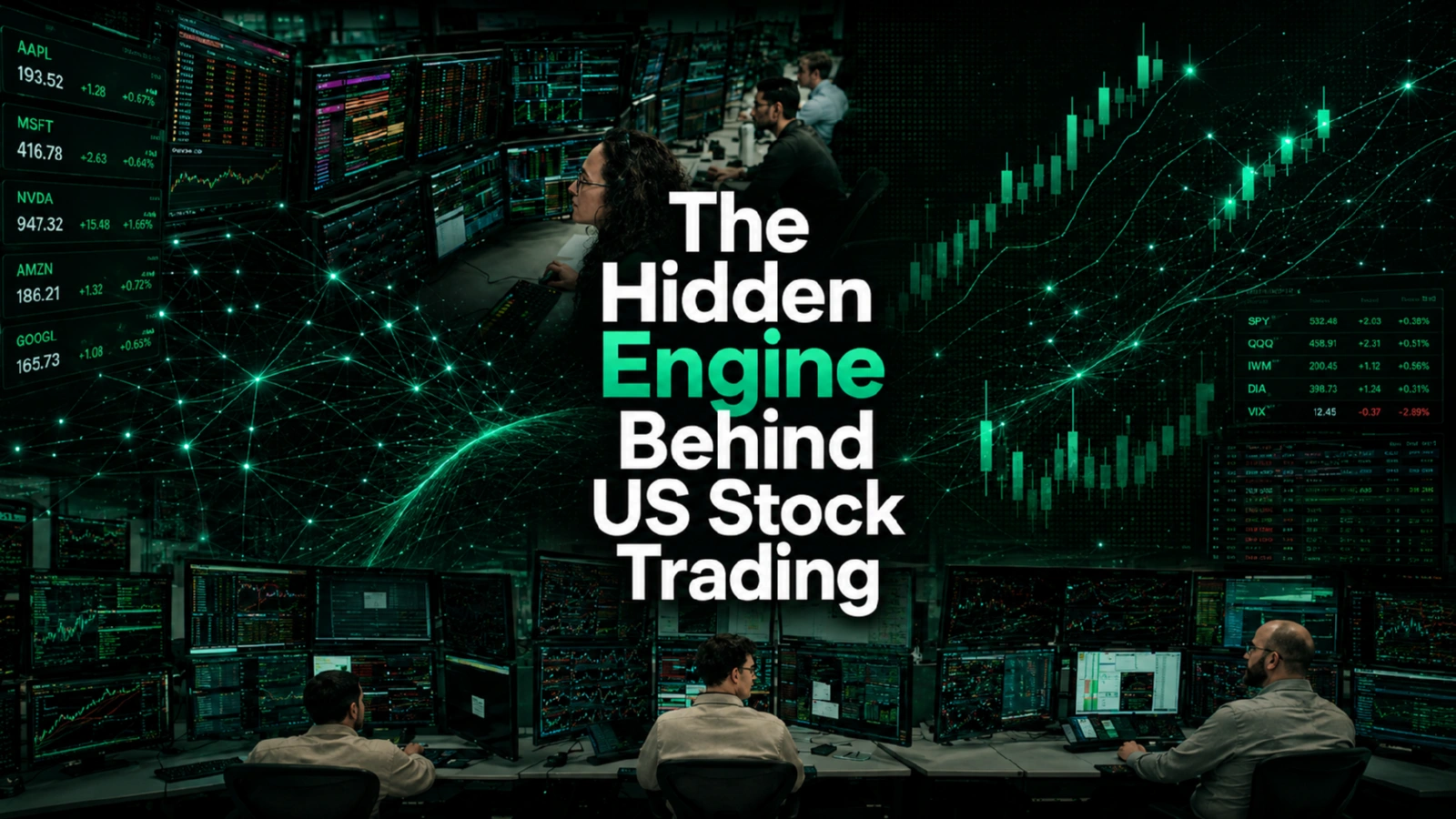
Every US stock trade depends on liquidity.Market makers continuously quote:Bid Price — price at which they buy
Ask Price — price at which they sellThey help investors execute trades quickly without waiting for another investor to take the opposite side.Key point: Market makers are the backbone of liquidity in US equities.
How NASDAQ Market Making Works
NASDAQ allows multiple market makers to compete in the same stock.Large companies such as Apple, Microsoft and NVIDIA can have many firms competing to provide liquidity.Major market makers include:
Citadel Securities | Jane Street | Virtu FinancialMore competition generally leads to:
Higher Liquidity → Tighter Spreads → Better ExecutionUnlike simply matching one buyer with one seller, market makers continuously provide two-way prices.
Bid-Ask Spread: The Hidden Trading Cost
The bid-ask spread is the difference between the best buying and selling price.Example:
- Bid: $100.00
- Ask: $100.01
- Spread: $0.01
For liquid large-cap stocks, spreads can be extremely small.For small or micro-cap stocks, spreads can become much wider.Example:
- Bid: $9.50 | Ask: $10.00
- That $0.50 spread represents a 5% gap.
Wider Spread = Higher Hidden Cost
Why Liquidity Matters
Liquidity determines how easily you can enter or exit a stock without significantly moving its price.High Liquidity
- High trading volume
- Tight spreads
- Deep order book
- Lower price impact
- Easier entry and exit
Low Liquidity
- Lower volume
- Wider spreads
- Less market depth
- Greater price impact
- Higher execution risk
Liquidity can directly affect your actual investment return.
Don't Look at Volume Alone
To understand whether a stock is genuinely liquid, check these 5 indicators:
Trading Volume
- How actively is the stock traded?
Bid-Ask Spread
- What does it cost to cross from buyer to seller?
Market Depth
- How many shares are available near the current price?
Turnover Ratio
- How frequently does the stock's float trade?
Price Impact
- How much could your own trade move the price?
Also remember: a substantial amount of US stock trading occurs off-exchange through market makers, dark pools and other trading venues.
What Indian Investors Should Check Before Buying
Before buying a US stock, check:
- Bid-Ask Spread
- Average Daily Volume
- Market Depth
- Market Capitalisation
- Regular vs Pre/After-Market Session
- Market Order vs Limit Order
Be particularly cautious in small-cap, micro-cap and low-volume stocks, where spreads and price impact can be significantly higher.Key Takeaway
Don't evaluate only the stock. Evaluate the market around the stock.Better Liquidity → Better Execution → Lower Hidden Costs
Want a Chartered Accountant on your return?
Book a free demo and see how FINWEL files, reviews and advises, end to end.
On this page
Start managing your money with FINWEL.
Create your account and file, invest and plan, with a Chartered Accountant in your corner.