
What is a credit risk fund?
Team FINWEL · 30 Jul 2026 · 5 min read
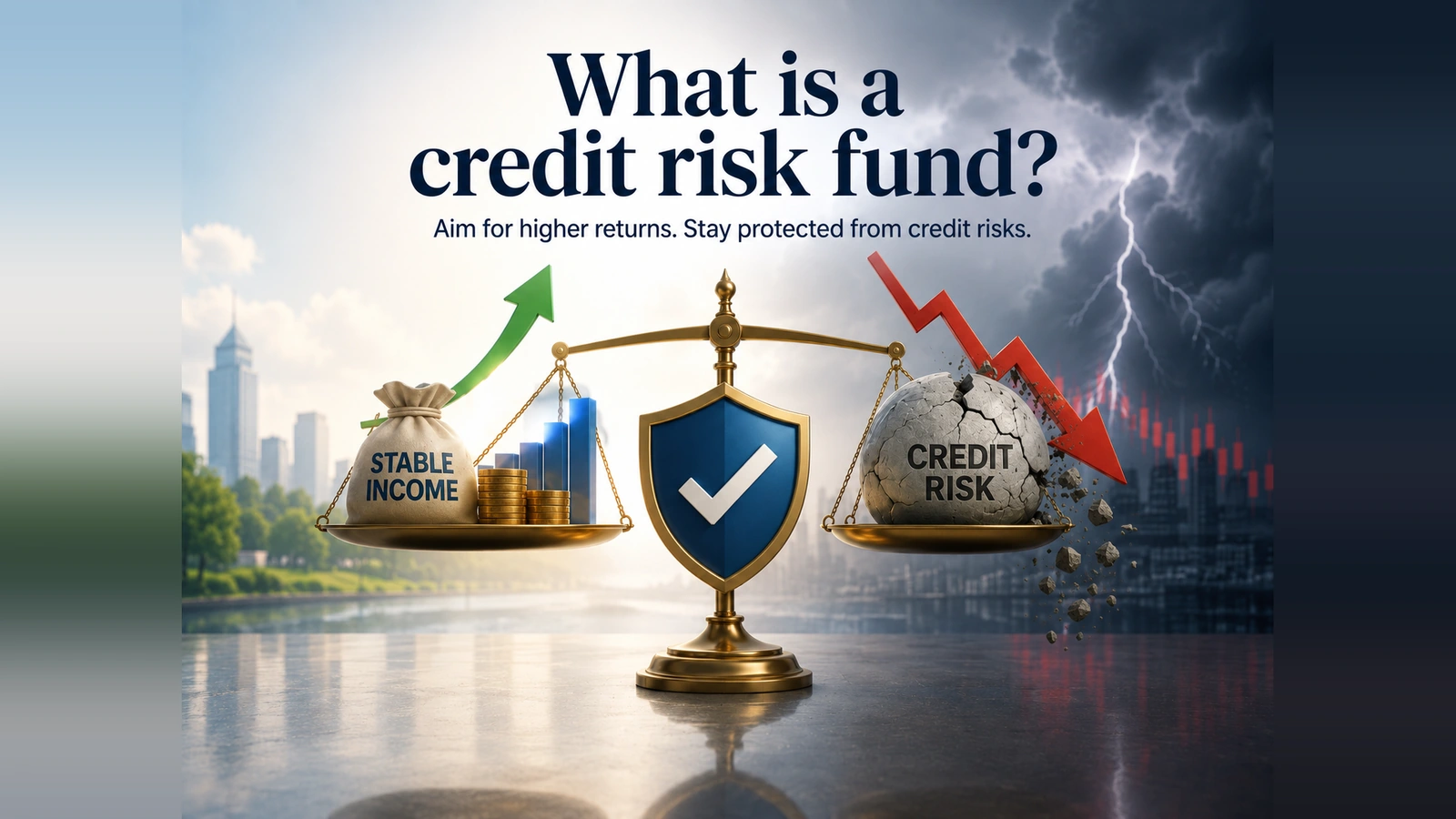
A credit risk fund is a debt fund that lends deliberately to lower rated borrowers because they pay more. The higher yield is not a bonus. It is the compensation for accepting the possibility that some of those borrowers do not repay. Anyone considering one should understand what that trade actually involves, because it is the category where the gap between the headline yield and the eventual outcome has been widest.
The definition is a rule, not a description
Under SEBI's scheme categorisation framework, a credit risk fund must hold a minimum of 65 per cent of its total assets in corporate bonds rated AA and below. AA in that phrasing includes AA+ and AA-, so what the rule excludes is the highest rated paper.
That is worth restating plainly. A credit risk fund is required by its mandate to take credit risk. It is not a fund that happens to hold some lower rated bonds. Holding them is the mandate, and a manager cannot retreat entirely to safety without breaching the category.
Where the extra yield comes from
A borrower rated AA pays more than one rated AAA because lenders demand more to carry the additional risk of not being repaid. The difference is the credit spread.
The manager's job is to be paid more for that risk than the risk eventually costs. Do it well, across a portfolio, and the extra yield exceeds the losses. Do it badly, or meet a bad year, and it does not. The spread is a price for risk, not a free improvement in return.
The two risks, and they are separate
Credit risk
A borrower is downgraded or defaults. The fund's holding is written down, and the net asset value falls. This can happen quickly and by a large amount when a single issuer is a meaningful part of the portfolio.
Liquidity risk
Lower rated bonds trade thinly. In calm conditions this is invisible. Under stress, when many holders want to sell the same paper, buyers are scarce and prices move against the seller. If a fund faces heavy redemptions at the same moment, it may have to sell into a market that will not absorb the volume.
Liquidity risk is the one investors underestimate, because it is absent from every ratio in the factsheet and present in every difficult period.
What happens when a holding goes wrong
On a credit event SEBI permits a fund to create a segregated portfolio, commonly called side pocketing. The affected holding is separated from the main portfolio. Existing investors receive units in the segregated portfolio, which pay out whatever is eventually recovered, while the main scheme continues.
The purpose is fairness. Without it, investors who redeemed early would exit at a net asset value that had not yet absorbed the loss, leaving those who stayed to carry all of it.
Indian investors also have a documented case of the more severe outcome. In April 2020, Franklin Templeton wound up six debt schemes, citing illiquidity in lower rated paper amid redemption pressure. Investors could not access their money on the normal terms and repayment came over an extended period through the winding up process. Whatever view one takes of the decisions involved, it established that in this category the risk is not only that returns disappoint. It is that access to your money may be interrupted.
Taxation
For AY 2026-27, a fund investing more than 65 per cent of its proceeds in debt and money market instruments is a specified mutual fund under section 50AA. Gains on units acquired on or after 1 April 2023 are treated as short term capital gains regardless of how long you held them, taxed at your slab rate, with no indexation.
A credit risk fund sits squarely inside that definition. So there is no long term rate to wait for, and holding on for years does not improve the tax treatment. Income distributions are added to your income and taxed at your slab rate, with tax deducted at source by the fund house above the prescribed threshold.
What to examine in the portfolio
- The rating profile in detail, not just the average. How much sits in AA, in A, and below
- Issuer concentration. How much is in the largest single exposure and the largest five
- Group concentration, since separate issuers can share a promoter
- The portfolio yield to maturity against comparable funds. A yield well above peers means more risk has been taken, not more skill
- The trend in assets under management. Sustained outflows are the condition that turns a credit problem into a liquidity problem
- Whether the fund already holds a segregated portfolio, and what it contains
- How much of the portfolio could realistically be sold in a week under stress
The question to answer before buying one
Not whether the yield looks attractive relative to safer options, because it always will. The question is whether you can accept a sharp fall in value, and possibly restricted access to your money, at a time you did not choose. If that would force you to sell at the worst moment or disrupt something else you had planned for, the extra yield is unlikely to compensate you for the position it puts you in.
These are legitimate, regulated products serving a real purpose for investors who understand them. They are not a slightly better fixed deposit, and the years in which they were sold as one did considerable damage to people who trusted the comparison.
Want a Chartered Accountant on your return?
Book a free demo and see how FINWEL files, reviews and advises, end to end.
On this page
Start managing your money with FINWEL.
Create your account and file, invest and plan, with a Chartered Accountant in your corner.