
What is a Nifty ETF?
Team FINWEL · 30 Jul 2026 · 4 min read
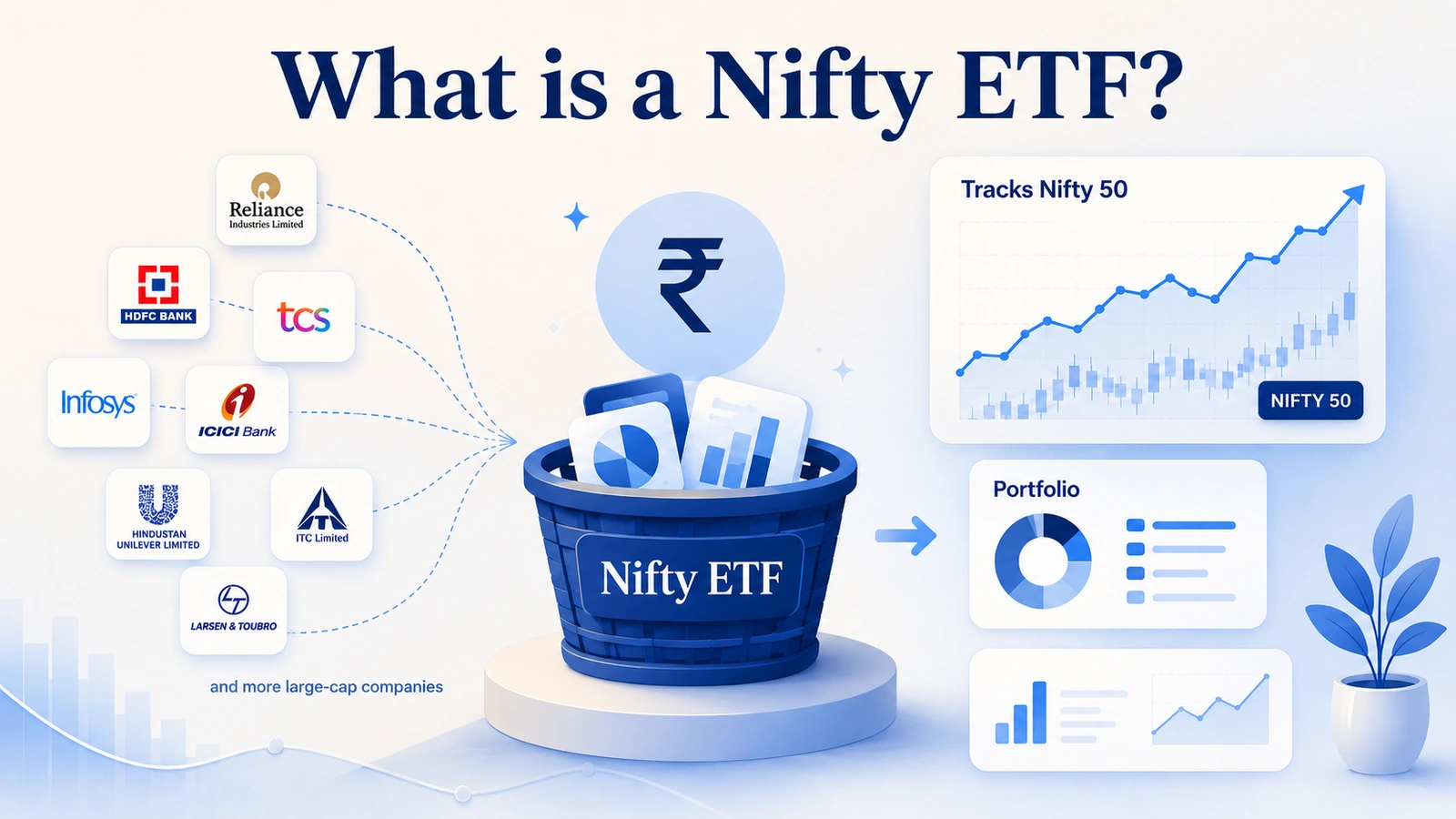
A Nifty exchange traded fund holds the fifty companies in the Nifty 50, in the weights the index assigns, and trades on the exchange like a share. It is the simplest equity product available in India and also the most misunderstood, because most of what determines your outcome is decided by the index rather than the fund.
What the Nifty 50 actually is
Fifty of the largest and most liquid companies listed in India, selected by rule and weighted by free float market capitalisation. Free float means the shares actually available to trade, so a company with a large promoter holding carries a smaller weight than its total market value would suggest.
Constituents are reviewed periodically. A company that grows enters, one that shrinks leaves, and the fund follows. Nobody exercises judgement about whether an entering company is good value.
Weighting has consequences most investors do not expect
Because weights follow market value, the index is concentrated. A small number of the largest companies account for a substantial share of it, and financial services has historically been the heaviest sector by a wide margin.
So a Nifty exchange traded fund is a diversified holding in the sense of holding fifty companies, and a concentrated one in the sense that a handful of names and one sector drive much of the result. Both statements are true and the second is the one that gets omitted.
The other consequence is directional. As a company's price rises its weight rises, so the fund holds more of what has already gone up. That is how the method works. It is not a judgement that the shares are attractively priced.
Judging how well a Nifty fund does its job
Not by returns, since every fund on the same index should produce nearly the same returns. By the gap to the index.
One point to get right when you compare. The Nifty 50 is commonly quoted as a price index, which excludes dividends, while the fund receives dividends from its holdings. Comparing a fund against the price index will flatter it. The correct comparison is against the total return version of the index, which includes dividends reinvested.
Then look at tracking difference, the actual gap over several periods, and expect it to be roughly the expense ratio plus a little. A fund that trails by considerably more is not tracking well.
Liquidity varies enormously, and it is not the same as size
Several Nifty exchange traded funds are listed and their traded volumes differ by orders of magnitude. A fund with large assets can still trade thinly, because most of those assets may be held by institutions that do not trade.
Thin trading shows up as a wide bid and ask spread and as persistent premiums or discounts. If you pay a premium of a few tenths of a per cent on entry and sell at a discount on exit, you have given away more than a year of the expense ratio in two transactions.
The wider family
- Nifty 50, the fifty largest
- Nifty Next 50, the following fifty, more volatile and less liquid
- Broader indices covering one hundred, two hundred or five hundred companies
- Sensex funds, tracking thirty companies on the other exchange, with substantial overlap
- Sectoral and thematic indices, narrow by design
- Factor indices selecting on rules such as low volatility, quality or momentum
These are not interchangeable. A Nifty Next 50 fund behaves quite differently from a Nifty 50 fund despite the similar name.
Tax treatment
A Nifty exchange traded fund holds more than sixty five per cent in domestic equity, so it is an equity oriented scheme. Securities transaction tax applies on exchange trades. Gains on units held twelve months or less are short term. Gains on units held longer are long term, taxed at twelve and a half per cent, with the annual exemption for long term equity gains available across your equity holdings taken together.
What to check
- Whether the fund's stated benchmark is the total return index
- Tracking difference over one, three and five years rather than a single period
- Traded volume over recent days, and the spread at the time you plan to trade
- The premium or discount to indicative net asset value before you place an order
- The expense ratio, and how it compares to other funds on the same index
- Whether an index fund on the same index suits you better, if you invest monthly in small amounts
Want a Chartered Accountant on your return?
Book a free demo and see how FINWEL files, reviews and advises, end to end.
On this page
Start managing your money with FINWEL.
Create your account and file, invest and plan, with a Chartered Accountant in your corner.